Your pet's microchip: which registry holds it, and how to update it
Verified 7 October 2026 · general information, not legal or veterinary advice
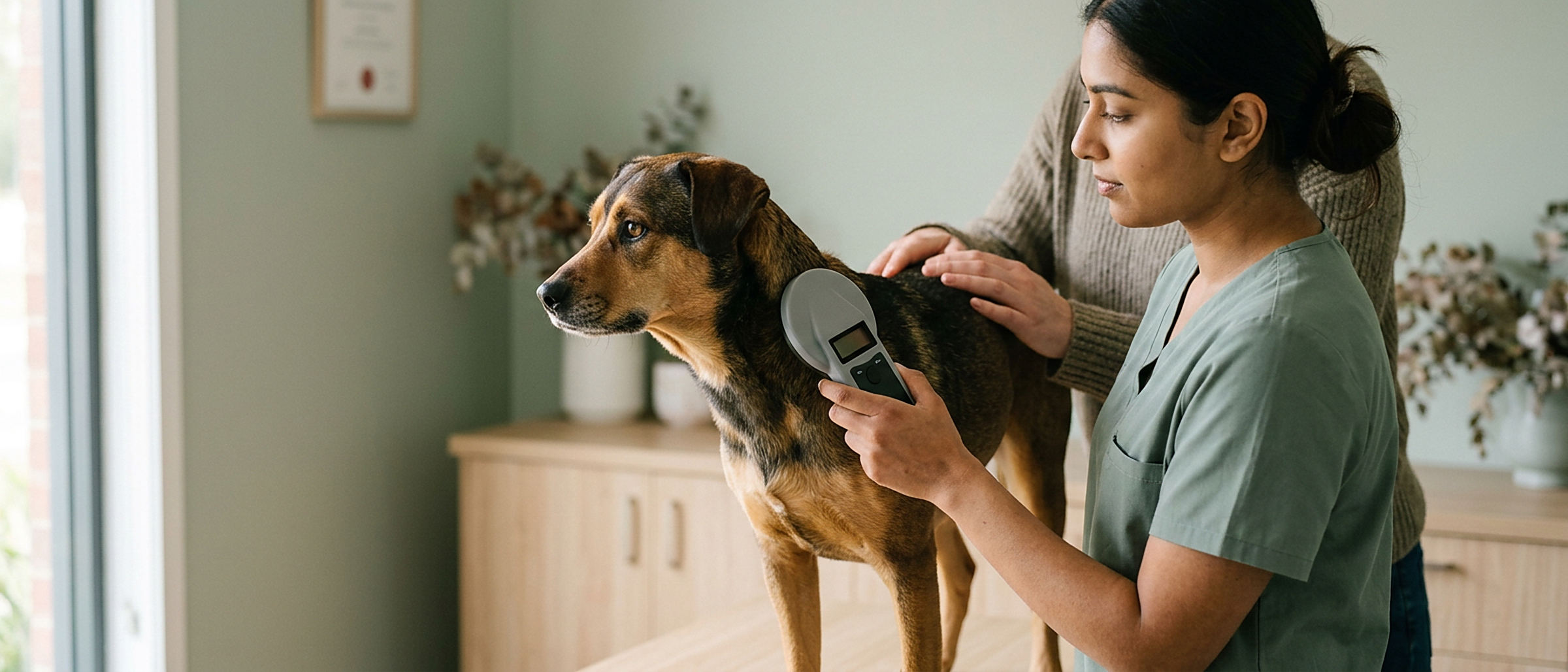
A microchip only works if the phone number attached to it is one you still answer. The chip itself is a number — fifteen digits, nothing more. The part that reunites you with your animal is a record on a database, held by a company you may never have chosen and probably cannot name.
Most people find this out at the worst possible moment. This page is the twenty minutes that avoids it.
Start with the number
You need the fifteen digits. In rough order of how quickly you will find them:
- The certificate of identification you were given when it was implanted — paper or email.
- Your adoption or purchase paperwork. Rescues and breeders almost always list it.
- Your vet. It is in their record, and they will read it out over the phone.
- Any vet, council pound or shelter will scan your animal for free if you walk in with them.
Find out which registry holds it
Australia has no single national microchip database. There are several private registries plus, in two states, a government one. The number itself does not tell you which.
PetAddress is the lookup layer: enter the number and it tells you which registry to go to. Two state governments send owners straight there — the ACT’s advice is simply “To update your details for your cat’s microchip, please visit Pet address”.
⚠️ It is not a complete national search. PetAddress is run by a committee of four registries and searches those four. It does not cover the NSW government registry, South Australia’s Dogs and Cats Online, or Greyhound Racing Victoria. A “not found” result does not mean your pet has no record — and if you live in NSW or SA, start with your state system instead.
Tasmania’s government sets out the sequence most clearly, and it works anywhere:
- Enter the microchip number at PetAddress.
- If it finds a registry, go to that registry and check every field — not just the phone number.
- If it finds nothing, and you are not in NSW or SA, register the chip with one of the operating registries yourself.
⚠️ If the answer is HomeSafeID, or nothing at all
HomeSafeID has closed, and its website no longer responds. If your animal’s chip was registered with it, read this section before you do anything else.
HomeSafeID ran a microchip registry used across Australia. It stopped. Three jurisdictions have confirmed it independently:
“HomeSafeID’s animal registry closed in February 2025. It is no longer licensed under the Domestic Animals Act 1994 to run a microchip registry service in Victoria.”
Agriculture Victoria — Domestic animal (microchip) registries“Tasmanian cat owners are urged to check microchip details, as the pet microchip registry HomeSafeID is no longer operating.”
Department of Natural Resources and Environment TasmaniaWestern Australia removed it from the list of registries allowed to hold WA records in July 2025. As of October 2026 its website does not load at all.
What happened to the records depends on where you live, and this is the part that catches people. Victoria’s transfer was explicitly limited to Victorian animals:
“All Victorian records for cats, dogs and horses were transferred to Central Animal Records. This service contacted affected pet owners and helped them update their records.”
Agriculture VictoriaSo if your animal was chipped in Victoria, your record very likely moved to Central Animal Records and somebody tried to tell you. If it was chipped anywhere else, no equivalent promise has been made in public. Western Australia struck the registry off a list. Tasmania tells owners to go and look, and to re-register if nothing turns up.
The practical consequence is worth stating plainly, because nobody is going to write to you about it: your animal may be carrying a chip that leads nowhere. It will still scan. The number will still be read correctly at the pound. There will simply be no record at the other end.
Check now, and if PetAddress finds nothing, register the chip yourself with one of the operating registries. You do not need a vet to do it and you do not need a new chip — the number in your animal is permanent, and registering it is paperwork.

The thing almost everybody gets wrong
Your microchip record and your council registration are two different things, held by two different organisations. Updating one does not update the other. Western Australia puts it in a single sentence:
“Microchipping a dog or cat does not register them with the local government.”
wa.gov.au — Microchipping cats and dogsSo when you move house there are usually two phone calls or logins, not one. The exceptions are New South Wales and South Australia, where the state runs a single system that does both.
Where your record lives, state by state
| Where | How it works |
|---|---|
| NSW | One government system, the NSW Pet Registry, covering both the chip and lifetime registration. “Cat and dog owners in NSW are required, by law, to keep their personal details and pet’s information up to date.” Update online through MyServiceNSW, or by form to your council — free either way. One government system NSW Office of Local Government |
| SA | Dogs and Cats Online — “South Australia’s database for microchips, local council dog and cat registration and breeder registration”, used by all 68 councils. Registrations expire 30 June each year. If you are not a verified online user you have to go through your council. One government system dogsandcatsonline.com.au |
| VIC | Five licensed private registries; a registry taking Victorian records must hold a departmental licence. Council registration is separate. Private + council Agriculture Victoria |
| WA | Four prescribed registries. Dogs chipped by 3 months, cats by 6, and any animal before it changes hands. Council registration is separate and the government says so outright. Private + council wa.gov.au |
| QLD | Compulsory for all cats and dogs from 8 weeks, since 1 July 2009. Private registries, with council registration separate. Private + council Queensland Government |
| TAS | Cats over four months must be microchipped and desexed under the Cat Management Act 2009. Four private registries; council registration separate. Private + council NRE Tasmania |
| ACT | Registration runs through an ACT government portal and renews annually, free. The chip itself sits on a private registry — the ACT points owners to PetAddress to update it. Private + portal ACT City Services |
| NT | There is no territory-wide rule, and councils genuinely differ. In Darwin, microchipping is a condition of registration under council by-law. In Alice Springs, dogs and cats register from six months and being microchipped only changes the fee. The NT Government publishes no microchipping requirement of its own. Check your own council, and do not assume the next one along matches. Council by council City of Darwin; Alice Springs Town Council; NT Government |
When you move, or when the animal does
Three states put a clock on it:
- Western Australia — update your details with a prescribed registry within seven days of moving or of the animal changing hands.
- New South Wales — fourteen days to notify by form, and it is free.
- Victoria — the clock runs the other way: the implanter has two days to send a new chip’s details to a registry, and the registry four days to load them. A chip implanted this week should be findable next week.
If you are rehoming or selling an animal, transfer the record rather than leaving your own details on it. In WA every cat and dog must be microchipped before it goes to a new owner, and a record still pointing at you means the next call about that animal comes to you — sometimes years later.
Moving interstate
The chip does not change and the registry does not care which state you live in — but the rules around it do. Your record sits with a registry licensed or prescribed where the animal was chipped, and your new state may run a system that one does not feed into. Moving to NSW or South Australia is the case to watch: both run their own government databases, and being on Central Animal Records does not put you on either of them. Register with your new council and ask them directly whether that also covers the chip.

What a registry owes you
Victoria publishes the conditions a licensed registry has to meet, which is a useful picture of what to expect anywhere:
- “Registries must provide 24-hour access so individual animals can be reunited with their owners.”
- “Registries must communicate with each other to identify the owner of an animal if the details are not on their registry.” So if one registry cannot find your animal, ask them to check with the others before you give up.
- A certificate of identification explaining how to change your contact details or transfer ownership.
- “Records must be maintained for the life of the animal or 30 years after a record is first established – whichever is the greater.”
- A separate backup of every record, updated at least monthly.
A ten-minute check, once a year
- Look up the number at PetAddress and confirm which registry holds it.
- Log in and check every field — mobile, landline, email, street address, and your emergency contact if there is one. An old email address is as bad as an old phone number.
- Check your council registration separately, unless you are in NSW or SA.
- Write the chip number down somewhere that is not the registry, so you can find it next time without ringing the vet.
Pick a date you will remember — a birthday, or the day the council registration falls due — and do it then.
Keeping your own copy
That is what Mabel.Pet is for. One timeline per animal — vaccinations, medications, weights, vet visits, symptoms, costs — on your phone and in any browser, and exportable in full whenever you want it, including if you stop paying us.
General information, not veterinary or legal advice. Rules differ between states and change over time. The sources below were current on 7 October 2026. If you have a dispute with a practice, consider getting your own advice.
Questions people ask
How do I find my pet’s microchip number?
Your certificate of identification, your adoption or purchase paperwork, or your vet — it is in their record and they will read it out. Any vet, council pound or shelter will also scan your animal for free if you take them in.
My pet is microchipped. Does that mean they are registered with the council?
Not in most of Australia. Western Australia states it plainly: microchipping a dog or cat does not register them with the local government. They are two records held by two organisations, and updating one does not update the other. New South Wales and South Australia are the exceptions, where the state runs a single system that covers both.
PetAddress says my microchip was not found. What does that mean?
Three possibilities. Your record may be on a system PetAddress does not search — it covers four registries, not the NSW Pet Registry, South Australia’s Dogs and Cats Online, or Greyhound Racing Victoria. The number may have been mistyped. Or the chip was never registered, or was registered with a registry that has since closed. If you are in NSW or SA, check your state system first; otherwise register the chip yourself.
My chip was with HomeSafeID. Do I need a new one?
No. The chip is permanent and the number does not change — what stopped is the database it pointed at. Look the number up at PetAddress; if nothing comes back, register it with one of the operating registries. If your animal was chipped in Victoria the record was most likely moved to Central Animal Records, which contacted affected owners.
Is there a fee to change my details?
It varies by registry and state. Changing your details on the NSW Pet Registry is free. Private registries may charge a small fee for a change of ownership, though a change of address is usually free. Ask before you assume either way.
I am rehoming my pet. Whose details should be on the chip?
The new owner’s, and it is worth making sure it actually happens rather than assuming. A record still pointing at you means the next call about that animal — from a pound, a vet, or somebody who found them — comes to you, possibly years later. In Western Australia every cat and dog must be microchipped before being transferred to a new owner.
I live in the Northern Territory. What applies to me?
Your council’s rules, and they are not the same across the Territory. Darwin makes microchipping a condition of registering your animal; Alice Springs registers dogs and cats from six months and treats microchipping as something that changes the fee rather than a requirement. The NT Government sets no microchipping rule of its own. So the answer is whatever your own council says — and a friend in another NT town may honestly tell you something different and be right.
How often should I check?
Once a year, and any time you change your phone number, email address or home. Most people only discover a stale record when their animal is already missing, which is the one moment it cannot be fixed quickly.
Sources
- PetAddress — petaddress.com.au, the lookup service run by the Pet Address Committee
- Agriculture Victoria — Domestic animal (microchip) registries, page updated 7 July 2026
- NSW Office of Local Government — Update your details on the NSW Pet Registry
- Dogs and Cats Online — South Australia’s database for microchips and council registration
- Government of Western Australia — Microchipping cats and dogs
- Department of Natural Resources and Environment Tasmania — Desexing and microchipping
- ACT City Services — Cats
- City of Darwin — Pet registration and microchipping
- Alice Springs Town Council — Register a pet
- Northern Territory Government — Pet owner responsibilities (the only NT Government page matching “microchip”; it treats microchipping as a cost, not a requirement)
All accessed 7 October 2026.